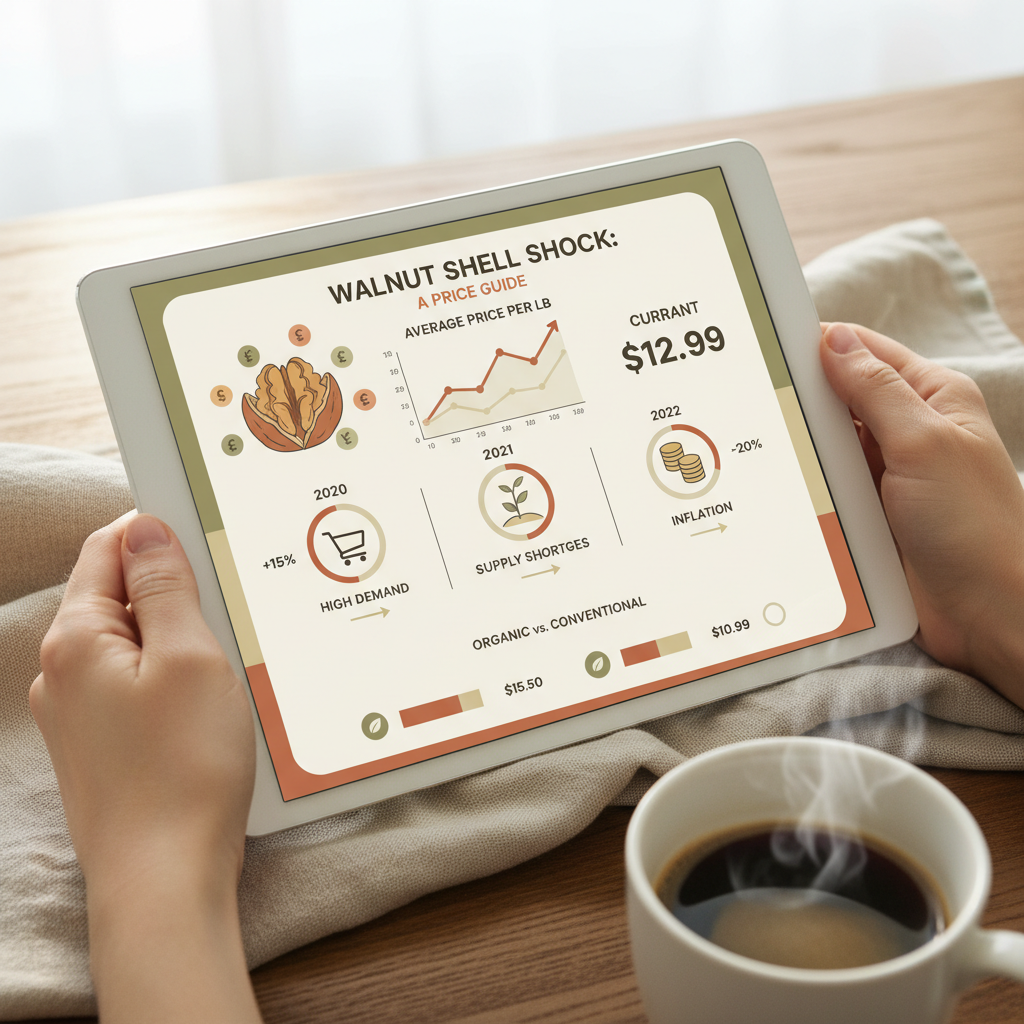
Finding a consistent and fair walnut 1 2 kg price often proves challenging for commercial buyers and health-conscious consumers alike, as pricing fluctuates based on shell thickness, kernel yield, and origin. Whether sourcing for retail packaging or industrial food processing, understanding the variables that drive the cost per kilogram is essential for maintaining budget stability.
The valuation of walnuts is not merely about weight but is deeply tied to the biological quality of the nut, specifically the ratio of the kernel to the shell. For instance, the Xinjiang Paper Shell 185 variety offers a significantly higher yield than standard thin-shell options, which directly impacts the effective price per usable kilogram of nut meat.
By analyzing the current market dynamics and the processing capabilities of integrated factories, procurement officers can better navigate the trade-off between raw volume costs and the final quality of the product delivered to the end consumer.

Understanding the Cost Drivers of Premium Walnut Varieties

When evaluating the walnut 1 2 kg price, the first critical factor is the origin and the specific cultivar. Chinese walnuts, particularly those from Xinjiang and Hebei, are categorized by their shell properties. A "thin-shell" designation is not just a descriptor but a financial metric; the thinner the shell, the lower the waste during processing, which increases the actual value of the 1-2 kg purchase.
Market volatility is further influenced by the harvest cycle and storage conditions. Factories that utilize large-scale cold storage, such as 1000-ton facilities, can stabilize supply and pricing year-round, preventing the sharp price spikes typically seen during the off-season. This infrastructure ensures that the moisture content remains below 5%, preserving the crispness and nutritional integrity of the kernel.
Furthermore, the level of processing—ranging from raw in-shell walnuts to stripped kernels—alters the price point. A buyer purchasing in-shell walnuts must account for the labor and machinery costs of cracking, whereas buying stripped kernels shifts that cost to the manufacturer, often resulting in a higher price per kilogram but lower operational overhead for the buyer.
Technical Specifications Affecting the Kernel Yield Ratio
The true economy of a walnut purchase is found in the "Yield Percentage." For a professional buyer, the gross weight of the shell is a sunk cost, and the kernel is the only value-adding component. High-end varieties like the Xinjiang Paper Shell 185 can reach yields of 60%-65%, meaning significantly more edible product per kilogram compared to standard grades.
Technical parameters such as size (e.g., 30mm+ or 32mm+) and shell thickness are strictly monitored using machine screening and air separation equipment. These processes remove empty shells and non-compliant fruits, ensuring that the final weight delivered is composed of high-quality, full-bodied nuts rather than filler material.
Beyond size, the color and smoothness of the shell often correlate with the internal quality of the kernel. Professional production lines employ X-ray separation and infrared light machines to remove malignant impurities, which ensures that the final product meets BRC food safety certifications, adding an intangible but necessary value to the price.
Industrial Applications and Commercial Packaging Scenarios
Walnuts serve diverse roles in the food industry, from raw snacks to high-value ingredients in confectionery and health foods. In retail, the 1-2 kg packaging is a popular consumer size, requiring automatic sealing and precise weighing to maintain margin accuracy. For these scenarios, the aesthetic appeal—the "out-looking" of the nut—becomes a primary price driver.
In the nutraceutical and health food sector, the focus shifts to the Omega-3 fatty acid content and alpha-linolenic acid (ALA). Walnuts are integrated into cereals, smoothies, and brain-health supplements because of their ability to support cognitive function and cardiovascular health. This high-value application allows producers to justify a premium price for kernels with superior white color and integrity.
From a B2B perspective, OEM and ODM customization services allow brands to tailor the packaging and labeling to specific regional markets, such as the Middle East or Europe. This value-added service transforms a raw commodity into a retail-ready product, shifting the pricing model from "price per kg" to "price per unit."
Comparative Analysis of Quality Benchmarks and Yields
Comparing different walnut grades reveals a clear correlation between shell thickness and financial efficiency. While lower-grade walnuts may have a lower initial price per kilogram, their lower yield percentages mean the cost per single gram of kernel is actually higher than that of a premium variety.
The following data illustrates the performance gap between standard industry benchmarks and high-yield varieties like the 185 Paper Shell. By focusing on yield, moisture control, and size consistency, integrated factories can offer a more predictable ROI for wholesalers.
walnut 1 2 kg price Performance Metrics
As demonstrated, the optimization of the production line—including color sorting and X-ray screening—significantly reduces the presence of impurities and empty shells. This technical rigor ensures that the buyer is not paying for waste, effectively lowering the real-world cost of procurement.
Procurement Strategies for Optimizing Bulk Nut Sourcing
Successful procurement of walnuts requires a shift from "lowest price" to "lowest cost per kernel." A buyer should evaluate the supplier's integration—specifically whether they are a trade company or a factory that integrates planting and processing. Sourcing directly from a factory with its own planting base reduces intermediaries and ensures a more stable price point.
Key evaluation metrics should include the BRC quality system certification and the presence of professional production lines. A factory capable of daily outputs of 50 tons can handle mass production without compromising on the manual re-inspection process, which is critical for removing the last 1% of defects that machines might miss.
Additionally, buyers should negotiate based on "inventory availability." The ability of a supplier to maintain a year-round stock in cold storage protects the buyer from seasonal price spikes and ensures that delivery timelines are met, preventing stock-outs in the retail chain.
Future Market Shifts in Nut Processing Technology
The nut processing industry is likely to see a further increase in automation, particularly in the sorting and peeling stages. The adoption of higher-precision X-ray separation equipment is expected to further reduce malignant impurities, potentially creating new "ultra-pure" grades that command a higher market premium.
Sustainability in planting is another emerging trend. As consumers demand more transparency, the move toward certified planting bases that prioritize soil health and water efficiency may influence the long-term cost of production. This transition could lead to a bifurcation in the market between "commodity grade" and "sustainably sourced" walnuts.
Digitalization of the supply chain will likely allow for real-time tracking of moisture levels and storage temperatures from the factory to the destination. This transparency will reduce the risk of spoilage and allow for more dynamic pricing models based on the actual freshness of the batch delivered.
Selection Guide for Different Commercial Grade Walnuts
Choosing the right walnut grade depends entirely on the intended end-use and the target consumer's price sensitivity. For a luxury retail product, the focus should be on kernel color and size, whereas for industrial baking, the yield percentage and bulk price are the primary considerations.
The following table provides a technical comparison of available varieties to help procurement officers align their selection with their business goals.
| Walnut Variety | Yield Percentage | Primary Feature | Best Use Case |
|---|---|---|---|
| Xinjiang Paper Shell 185 | 60%-65% | Thinnest shell, high yield | High-end retail packaging |
| Xin 2 Thin-shell | 52%-55% | Smooth shell, best taste | Health food ingredients |
| 33 Thin-shell | 48%-51% | Superior visual appearance | Gift boxes and luxury sets |
| Xinfeng Thin-shell | 47%-50% | Competitive bulk pricing | Industrial bakery and confectionery |
| 185 Thin-shell | 51%-53% | Top white kernel quality | Export markets (EU/USA) |
| Standard Grade | 40%-45% | Basic nutritional value | Budget snacks and mass market |
By aligning the specific variety with the intended application, businesses can optimize their procurement costs while ensuring that the quality meets the expectations of their specific target demographic.
Frequently Asked Questions
Conclusion
Navigating the complexities of walnut procurement requires a technical understanding of the relationship between gross weight, shell thickness, and kernel yield. The apparent price per kilogram is only one part of the equation; the real value lies in the efficiency of the variety and the reliability of the supplier's processing infrastructure.
For businesses seeking a stable supply of high-quality Chinese walnuts, partnering with an integrated factory that controls the process from planting to packaging is the most effective way to mitigate risk and optimize costs. Readers evaluating these procurement factors can review the relevant product and company information available through www.luhuawalnut.com.